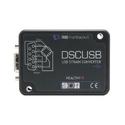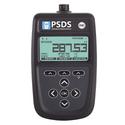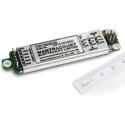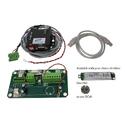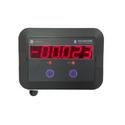














Strain Gauge to USB Convertor (DSCUSB)
View more videos on
Our YouTube Channel !
- Compact USB load cell signal converter for easy USB strain gauge and load cell acquisition
- Compact desk format powered from USB
- Ideal for portable test applications
- Strain gauge data acquisition for all bridge input sensors (weight, pressure, force, torque & more)
- High resolution 1 part in 400,000 (18bit)
- High speed to 500 updates per second
- Ability to communicate with multiple USB sensors
- Converts a conventional load cell to a USB load cell
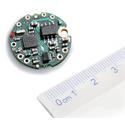
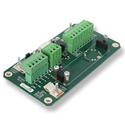
- OEM pcb version available (shown on thumbnail image on left)
The DSCUSB is a compact, high performance digital signal conditioner with USB connectivity aimed at applications requiring high accuracy measurement. Converts a strain gauge sensor input to a digital USB serial output. The converter is enclosed within a rugged metal case, making the device suitable for all indoor environments.
Ideal for all strain gauge bridge based sensors including strain, weight, load, force, torque, pressure & displacement, the device simply plugs into your PC where data can be acquired and manipulated by accompanying software.
Typical applications for the DSCUSB will be those requiring simple sensor connectivity in desk top settings such as test & measurement, R&D and laboratory environments. No additional power supply is required as the power is drawn from the USB bus. Although ideal for one-to-one interface, the device can connect with multiple sensors with the use of a suitable hub. Available in ASCII protocol.
Also available as OEM pcb module - please see product sheet for more information. This version has input and output ports for switch input and relay output.
| Hardware Specifications | |||||
|---|---|---|---|---|---|
| Parameter | Min | Typical | Max | Units | Notes |
| Supply Voltage Range | 4.35 | 5 | 5.25 | Volts | |
| Average Operational Current (normal mode) | 70 | 80 | mA | Note 1 | |
| Operating Temperature Range | -40 | 85 | Deg C | ||
| Storage Temperature Range | -40 | 85 | Deg C | ||
| Humidity | 0 | 95 | %RH | ||
| Note: 1. When connected to a 350 Ohm Load Cell. | |||||
| Bridge Measurement | |||||
| Measurement | Min | Typical | Max | Units | Notes |
| Strain Gauge Excitation System | 4 wire | ||||
| Strain Gauge Excitation Voltage | 4.5 | 5 | 5.25 | VDC | |
| Strain Gauge Drive Capability | 5000 | Ohms | |||
| Strain Gauge Sensitivity | -3 | 3 | mV/V | ||
| Offset Temperature Stability | 5 | 10 | ppm/C | ||
| Gain Temperature Stability | 30 | 50 | ppm/C | ||
| Offset Stability with Time | 35 | 160 | ppm of FR (1) | ||
| Gain Stability with Time | 300 | ppm of FR(2) | |||
| Non Linearity before Linearization | 5 | 25 | ppm of FR | ||
| Internal Resolution | 16 Million | Counts/Divs | |||
| Resolution @ 1Hz Readings (Noise Stable) over 100s | 66,000 | Counts/Divs | |||
| Resolution @ 10Hz Readings (Noise Stable) over 100s | 40,000 | Counts/Divs | |||
| Resolution @ 100Hz Readings (Noise Stable) over 100s | 10,000 | Counts/Divs | |||
| Signal Filter | Dynamic recursive type user programmable | ||||
| Communications (USB) | |||||
| The load cell to USB adaptor will communicate as a simple serial device rather than a ‘native’ USB device. Once the device is plugged into a PC and the supplied drivers are installed, the device will appear as a Virtual Serial Port to the PC. Standard Modbus drivers, configurations and libraries can be used with this device. Mantracourt will also supply a driver for its own ‘Instrument Explorer’ software. Because each device, when plugged into a PC, creates an additional serial port, the total number of devices that can be attached to the PC may be limited by the communication software’s ability to utilise these multiple ports i.e. an existing Modbus communication program may only support COM1 to COM4. |
|||||
| Support Modules | |||||
| Instrument Explorer Software | |||||
| Environmental | |||||
| Storage Temperature | - 40 to + 85ºC | ||||
| Operating Temperature | - 40 to + 85ºC | ||||
| Relative Humidity | 95% maximum non condensing | ||||
| CE Environmental Approvals | European EMC Directive 2004/108/EC | ||||

Software
Product order options
| Options | Code |
|---|---|
| Industrial Stability USB with ASCII protocol | DSCSUASC |
| USB Industrial Digitiser ASCII with Enclosure | DSCSUEASC |
| Industrial Stability USB with Modbus protocol | DSCSUMOD |
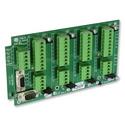
| Junction PCB with Field Connectivity for DSCUXXX | DSJ2 |
| USB Industrial Digitser Modbus with Enclosure | DSCSUEMOD |
These are the following industries and applications in which this product has been used:
- Test & Measurement - Health & Fitness Weighing Scales
- Test & Measurement - Force Testing
Strain Gauge or Load Cell Digitiser Module
Embedded Digital Load Cell Converter /Strain Gauge Digitizer Module
- Q: How do I communicate with the USB device?
A: Using a simple ‘Virtual Com Port’, the DSCUSB communicates as if the device is connected to a serial port. The device addressing allows up to 127 devices. The ASCII version allows for continuous output stream.
- Q: Is temperature sensing available?
A: An optional temperature sensor module (DTEMP) is available which will enable an advanced 5-point temperature-compensation of measurements.
- Q: Is there Linearity compensation?
A: Advanced 7-point linearity compensation available as standard.
- Q: Is there adjustable sensitivity?
A: Supplied pre-configured for standard 2.5mV/V full-scale strain gauges. A single additional resistor re-configures the input between 0.5 and 100 mV/V full-scale.
- Q: How stable is the device?
A: 25ppm/°C basic accuracy (equates to 16 bit resolution).
- Q: What is the calibration process?
A: Completely drift-free, adjustable in-system and/or in-situ via standard communications link. Two independent calibration stages for load cell and system-specific adjustments. Programmable compensation for non-linearity and temperature corrections. Calibration data is transferable between devices for in-service replacement.
- Q: Are there self-diagnostics capabilities?
A: Continuous monitoring for faults such as strain overload, over/under-temperature, broken sensors or unexpected power failure. All fault warnings are retained on power-fail.
- Q:What are the output options?
A: Choice of three different protocols for ease of integration: ASCII, MODBUS or MANTRABUS. All variants provide identical features and performance.
- Q: Tell me about low current
A: Functions as a ‘Low Power Device’ i.e. draws less than 100mA (one unit load) when connected to a 350 Ohm Bridge.