
















ATEX Certified 4-20 mA Load Cell Amplifier (ALA5)
.jpg&w=800&h=500&hash=49883233eca643ca0681ce356177c92a)
.jpg&w=800&h=500&hash=b4ea2d52b73ce9c47f0ed51f0d075177)
- Certified amplifier for ATEX hazardous zones 0, 1 & 2
- Designed for fitting in-line to strain gauge sensors such as load cells
- Intrinsically safe to EN60079-11
- Provides 2-wire 4-20 mA current loop output
- Environmentally sealed to IP67
- Fast calibration via gain and offset trim
- Bridge impedance min 350 Ohms max 5,000 Ohms
- Wide temperature range -40 C to +85 C
- Supplied with 1 m strain gauge cable and 5m output cable
- Robust design, reverse polarity & short circuit protected
- OEM option of the ATEX certificated miniature load cell amplifier available
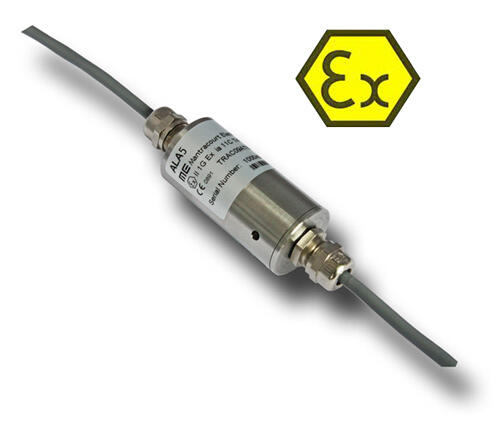
The ALA5 incorporates an ATEX certified 4-20 mA load cell amplifier designed for operation within hazardous zones 0,1 & 2
The high performance ATEX 4-20 mA load cell amplifier provides 2-wire 4-20 mA current loop output and connects in-line for a range of signal conditioning for strain gauges, load cells, pressure and torque transducers. Intrinsically safe to EN60079-11 (previously EN 50020) standards.
The ALA5 can be connected to ATEX approved equipment within the hazardous zone or to non-approved ATEX equipment outside the hazardous zone provided that a suitable barrier is used.
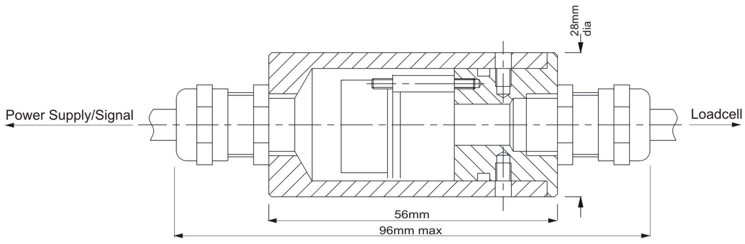
Designed for fitting in-line to strain gauge sensors such as load cells, the amplifier is housed within a stainless steel IP67 NEMA 6 EMC protected enclosure and is supplied with 1m strain gauge cable and 5 m output cable.
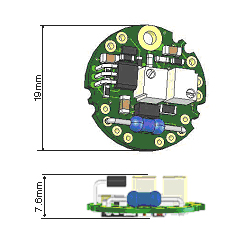
An OEM option is available for customers wishing to embed the ATEX amplifier within a sensor. Please note: the ICA5ATEX is approved for incorporation into load cells and other enclosures. Please contact us to discuss your requirements.
Evaluation units available for trial and evaluation at low cost. Click 'Quote / Price Request' top right to request more information.
| Parameter | Min | Typ | Max | Units | Notes |
|---|---|---|---|---|---|
| Electrical & Environmental | |||||
| Supply Voltage Range | 9 | 24 | 28 | Volts | |
| Operating Current | 4 | - | 20 | mA | |
| Operating temperature range | -40 | - | 85 | ºC | |
| Storage temperature range | -40 | - | 125 | ºC | |
| Reverse polarity protection | - | - | -28 | Volts | |
| Measurement | |||||
| Bridge excitation | 1.05 | 1.11 | 1.16 | Volts | 1000 Ohms load cell connected |
| Bridge impedance | 350 | 1000 | 5000 | Ohms | Recommended bridge impedance is 1000 Ohms |
| Bridge sensitivity | 0.5 | 2.5 | 55 | mV/V | Factory setting is the typical value shown. For other values an alternative calibration resistor can be fitted (see manual). |
| Output current range | 4 | - | 20 | mA | |
| Output load | - | - | 800 | Ohms | At 24V supply minimum |
| Bandwidth | DC | - | 1000 | Hz | |
| Zero adjustment | - | ±2 | - | %FR | |
| Span adjustment | - | ±8 | - | %FR | |
| Linearity | - | 0.02 | - | %FR | |
| Zero temp stability | - | 0.001 | 0.005 | ±%FR/ºC | |
| Span temp stability | - | 0.007 | 0.014 | ±%FR/ºC | |
| General Notes: | |||||
| The voltage between either of the power supply connections and the load cell shield should not exceed 50V. Any leakage will be greater than 10M Ohms. FR = Full Range |
|||||

.png&h=40&f=png&far=1&bg=FFFFFF&hash=d1c7fb09682d201239c9925607fc3432)

Documents
- ALA5 Product Sheet : ALA5 ATEX 4-20mA Load Cell Amplifier
- ALA5 and ICA5ATEX Manual : ATEX Certified 4-20 mA Load Cell Amplifier
Software
No relevant software available
Product order options
| ALA5 | Code |
|---|---|
| ATEX Certificated 4-20mA Load Cell Amplifier | ALA5 |
| Options | Code |
| ATEX Certificated Miniature Load Cell Amplifier (Intrinsically Safe) | ICA5ATEX |
These are the following industries and applications in which this product has been used:
- Hazardous Areas - Load Monitoring of Tank Weight in Explosive Atmospheres
- Hazardous Areas - Remote Display and Logging in Zone 0
- Q: What Strain Gauge parameters is the ALA5 designed for?
A: Designed for a 1k bridge, however, 350R can be used at the expense of noise and drift performance due to the reduced excitation voltage on the bridge. It is factory set for 2.5mV/V.
- Q: What do the ATEX markings mean?
 II 1 G Ex ia IIC T4
Tamb = -40°C to +85°C
CE0891 TRAC09ATEX1xxxXATEX Marking details
Explosion protection II Equipment group: industrial 1 Equipment category: very high protection G Hazard: gas atmosphere - zones 0,1 and 2 Certification Code details
Ex Explosion protection ia Intrinsic safety according to EN60079-11 (previously EN 50020) IIC Hydrogen/Acetylene gas group T4 Temperature Classification – surface temperature <135°C - Q: Are there different mV/V settings available?
A: The sensitivity can be set between 0.5 mV/V and 55 mV/V by changing the SPAN (gain) resistor. Please enquire with our Sales team for more info.
- Q: Can I extend the output cable on the ALA5?
A: Yes by use of an ATEX approved junction box.
Please refer to the manual for the EC examination certificate detailing the maximum allowable cable capacitance and inductance.- Q: What is the maximum cable length for the load cell connections?
A: Maximum is 2 metres.
- Q: Is a barrier needed for Zones 1 and 2?
A: Yes, a barrier is needed for all ATEX installations. Please contact us for more information.
- Q: Can I embed the OEM ALA5 device into my own loadcell?
A: Yes, the ICA5ATEX amplifier is designed to fit into a pocket in a certified loadcell.
Please note: OEM customers must hold a notified body Quality Assurance Notification (QAN) and ensure that the load cell and amplifier assembly is submitted for ATEX certification by an appropriate body.- Q: What is ATEX?
A: The term 'ATEX' comes from the French word 'atmosphére explosibles'. It is the name commonly given to the framework for controlling explosive atmospheres and the standards of equipment and protective systems used in them. It is based on the requirements of two European Directives. One that applies to equipment manufacturers and another for its end users, both Directives came into effect on 1 July 2003.
The ATEX regulation removes the need for separate testing by joining the technical and legal standards for manufacturing of equipment that may potentially be used in explosive atmospheres .
ATEX regulations apply to all equipment intended for use in explosive atmospheres, whether electrical or mechanical, and also protective systems. Manufacturers must ensure that their products meet essential health and safely requirements and undergo appropriate conformity procedures.